Starting class with an estimation strategies for irrational square roots warm-up gets students ready to think about numbers that do not have clean, whole-number answers. This brief exercise matters because it shifts learners away from exact calculation and pushes them toward spatial reasoning and approximation. When students learn to estimate rather than just calculate, they build a much stronger number sense that helps them catch calculation errors later on.
What does an irrational square root warm-up actually look like?
A warm-up in this context is a short, focused activity that activates prior knowledge of perfect squares before introducing non-perfect squares. Instead of handing out a calculator right away, you ask students to figure out where a number like the square root of 20 lives on a number line. The goal is not to find the exact decimal to the hundredths place. The goal is to identify the two consecutive whole numbers the irrational root falls between, and then make a reasonable guess at the decimal.
When should teachers use these estimation warm-ups?
You should use these quick activities right before introducing formal rational approximations. They are also highly effective when transitioning from geometry topics, like the Pythagorean theorem, into algebra. If you are setting up a lesson plan for comparing rational approximations, starting with a five-minute estimation challenge gives students the intuitive foundation they need to understand why one approximation is larger or smaller than another.
How do you build a quick estimation activity?
Building a solid warm-up takes just a few minutes and requires three simple steps. First, anchor the students with perfect squares. Ask them to quickly recall the square roots of 16 and 25. Second, introduce the target non-perfect square, like 20, and ask them to identify the boundaries. They should recognize it falls between 4 and 5. Third, ask them to estimate the decimal. Since 20 is slightly less than halfway between 16 and 25, the square root should be slightly less than 4.5.
To make this stick, physical or visual representations help immensely. Incorporating a visual number line activity allows students to physically see the distance between whole numbers and plot their estimates, turning an abstract concept into a concrete spatial problem.
What are the most common mistakes students make?
When students first tackle irrational roots, they tend to fall into a few predictable traps. Watch out for these errors during your warm-up:
- Dividing by two: Some students will see the square root of 20 and simply divide 20 by 2 to get 10, confusing square roots with halving a number.
- Assuming linear middle points: Students often think the square root of 20 is exactly 4.5 because 20 is roughly halfway between 16 and 25. They forget that square root functions are not linear.
- Skipping the perfect square check: A student might try to estimate the square root of 36, not realizing it is already a perfect square with an exact whole-number answer.
How can you make estimation practice more engaging?
Repetitive worksheet problems can quickly drain the energy from a middle school classroom. To keep the momentum going after the warm-up, transition into interactive practice. Setting up an interactive math center game for estimating roots turns repetitive practice into a collaborative challenge. Students can work in pairs to plot roots on a giant floor number line or compete to see who can get the closest rational approximation without a calculator.
If you are designing your own warm-up slides or printing worksheet cards for these centers, using a clean, highly readable typeface like Montserrat keeps the numbers clear and easy to read from the back of the classroom.
What should you do next to reinforce the skill?
Once the warm-up is complete and the main lesson begins, you need to ensure the estimation skills transfer to independent work. Here is a practical checklist to guide your next steps:
- Have students write down their warm-up estimates and then use a calculator to check the actual values. Discuss how close they were and why their estimates might have been slightly high or low.
- Introduce the concept of tenths and hundredths by zooming in on the number line between the two whole numbers.
- Give students a real-world scenario, such as finding the side length of a square garden with an area of 50 square feet, and ask them to estimate the fencing needed.
- Pair students up and have them explain their estimation reasoning to each other out loud to solidify their mathematical vocabulary.
 Root Finders: the Estimation Game Center
 Comparing Rational Approximations of Square Roots
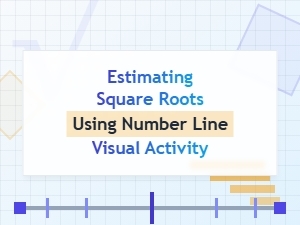 Visualizing Square Roots on a Number Line
 Estimating Square Roots Through Rational Approximations
 Mental Math Tricks for Estimating Square Roots
 A Simple Geometric Model for Estimating Square Roots